Jarvis Cocker’s talisman-peppered workspace, much like his prolific and idiosyncratic career as a musician, is a glimpse into the busy mind of a reluctant icon. Clutter and curios from a life well travelled define his cosy surroundings in the Shepherd’s Bush home he shares with his wife, the creative consultant Kim Sion.
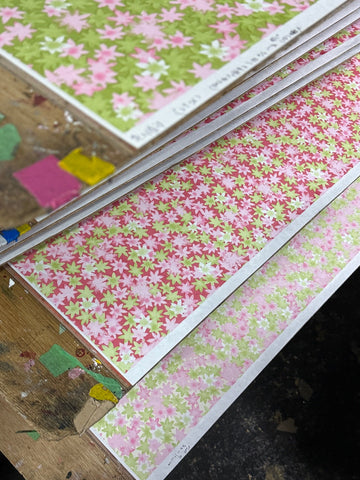
Cocker’s office was originally his son Albert’s bedroom. For a man whose ideas outpace the rate at which he can file them away, necessities cohabitate with the evocative: a lime-green armchair offers a splash of the unexpected, and the snaking 70s-inspired, almost hypnotic pattern of the wallpaper (also an Albert hand-me-down) imbues the small room with quiet dynamism. He is an artist who has long oscillated between the mundane and the magnificent, the wry and the theatrical.
In the age of sterile and overstyled ‘timeless’ interiors, the disarrayed office feels timefull – perhaps a clue as to how Cocker’s work has endured in the fickle, newness-obsessed realm of pop culture. Amid a Britpop renaissance, his longevity has been underscored by the recent comeback of his band, Pulp, with the release of ‘More’ (their first number one album in 27 years) and a surprise Glastonbury set prompting talk of a career high and ‘Pulp Summer’ headlines.

It’s easy to argue that Cocker was ahead of his time: his is a lexicon of contrasts, from class-conscious pop melodies infused with the vernacular of everyday life to witty, introspective discourse interwoven with quintessentially British pathos. Published in 2022, his memoir, Good Pop, Bad Pop, saw him sift through his attic for objects from his life in music, and his ever-growing stockpile of notes, drawings and mementos suggests more works are to follow. Below, he tells Choosing Keeping about the benefits of hoarding, his fear of being overheard, and his beef with the opera.
Choosing Keeping: How did you choose to decorate your office?
Jarvis Cocker: The desk itself was the starting point. This table came from an antique shop and was originally in a library in north London. It was very difficult to get it in – I don’t know if it’ll go out again. It’s a good size, and it’s very stable, which is important as I knew I’d put a lot of stuff on it. That’s who I am.
The legs are really on the edge of it, and there’s no cross bars, so nothing to bang your legs on. It drives you nuts when you bang your knees; it disturbs you. The marks were on it and had obviously been there for a long time. I liked the idea that it was a table people had worked at. I thought that might rub off on me.

CK: Did you have a desk as a child?
JC: It was an old dressing table that had been repainted by my mother, and I used it to do my homework. After that, I graduated to an old pub table, which had loads of fag burns on the pedestals – disgusting, actually.
I never really had a place that I’d work at as an adult. In the early days of being in a band I’d just write on envelopes and things like that. I didn’t even use notebooks that much. Notebooks I started using when I moved to Paris, for some reason. I’ve got quite a few good notebooks here. I started out with the black ones, Moleskines. I really liked them because of the finish and the little envelope to put rubbish in as I tend to pick up bits of rubbish.
CK: Do you keep old notebooks?
JC: Yes, but I realised I couldn’t tell which one was which. They look the same, so I started buying different notebooks. This is just the tip of the iceberg. We were working on new music and I was trying to see if I’d written anything of interest that I could use in lyrics. I went through them, but there’s loads more left somewhere.

CK: Do you remember why you came into Choosing Keeping all those years ago?
JC: I was living in east London, and you had the shop on Columbia Road; I didn’t go to Columbia Road that often because it was a bit too packed. I think you had some records in the window and then also there were those glass light mills that spin. I thought, I don’t really understand what this shop is, so I’ll go in and have a look.
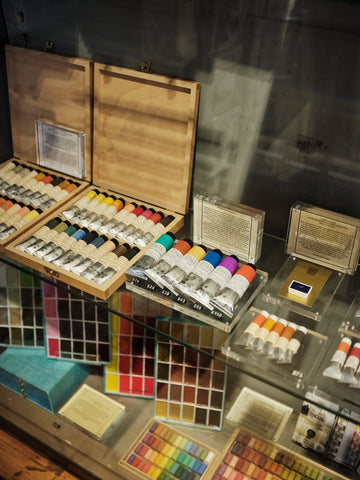
Probably the first thing that I bought was one of the four-colour gold pens, because I’d always liked pens with different colours and it was just such a nice object. And then I bought one of the light mills for a friend’s birthday.

CK: Light, records, tea, perfume, candles: what are the different things that might set the tone for good music writing? Do you think those are completely superfluous?
JC: You can do it anywhere, really. I mean this room is a good environment for writing, but for writing words for songs, there isn’t really an environment. I would say to be out and about because ideas for words for songs will come to me when I’m doing something else. If your brain is slightly occupied with doing something, then somehow it seems to allow things from your unconscious to float to the surface.
I’ve got a guitar in the corner, but it’s just in case I want to play a bit. I haven’t played it for quite a long time. I’ve got a studio up north that I use more for that, because you have to make noise. You can’t make a lot of noise in here with the neighbour right through that wall. That’s one thing that I have a pathological fear of: being overheard when I’m trying to write music.

CK: How does technology affect creativity for you?
JC: The sad thing now is I still use notebooks occasionally but I have started writing more on my phone, which I know is terrible. Typing and writing, they’re two different things. Someone once told me that if you write something, the way you hold the pen in your hand means you’re more emotionally connected to what you’re writing. Someone even says there’s a vein that goes directly to your heart. If I have to write an important letter to someone, I will always write it by pen, and I’ll type it out afterwards.
CK: Do you consider yourself a collector? A hoarder?
JC: Well, most of the stuff in this house is Kim’s. This painting here is by Kim’s daughter. She very kindly gave me that – I love it. And this office has become a bit of a repository for things I’ve been sent. For instance, that pencil drawing of me with the puppet Flat Eric on my shoulder was by a girl from Poland called Annie. That over there was something I was given for my 61st birthday. Over there is a representation of the Throbbing Gristle album cover, painted by someone I know. And that’s a thing that was sent by a fan. So it’s a kind of shrine. I suppose an excuse for being untidy is to say, ‘I might want to write about this object, so I have to have it within reach’.

CK: Do collections make you feel nostalgic?
JC: I’m not saying that I did this on purpose, but accumulating objects and then putting them in a loft and never really looking at them for a long time, thinking that they would come in useful at some point in the future did present a version of myself that I thought I was at that time. There is quite a lot of written stuff up in the loft, and when I get it out of the dark, the memories that come are really strong.
CK: Can you tell us about some special objects?
JC: Let’s think. A photograph. In this one that was taken for the local paper when we first got a BBC Radio John Peel Session back in 1981, I’m holding a tortoise. I don’t know why. And then Pulp took a long time to ever become well known, so I thought I was going to take life in the slow lane. I was going to be like a tortoise, not like a hare and become famous straight away. The photograph also reminds me of my mother because she bought a tortoise shell.
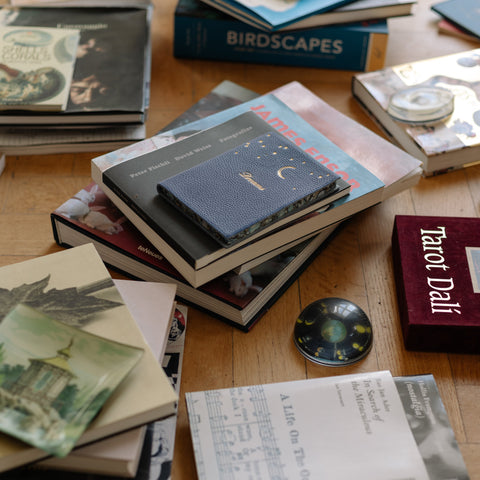
Another is a notebook with all the chords to Pulp songs in it, in case I forget them. And all my small books – I always fall asleep when reading in bed, so hardbacks just eventually fall on my face. I always resent how big and heavy books are. I love paperbacks. I hate the Kindle.

CK: If you had to time travel based on music of the era, what pre-20th-century time would you go to?
JC: I’ve stopped listening to Radio 2; I listen to Radio 3 now, so I’m starting to learn a bit about classical music, and I would maybe . . . where did Beethoven hang out? Where did they all go? Was it Leipzig or Vienna? Well, let’s go to Budapest. Anyway, wherever they all hung around is where I would go.
CK: Is it true you don’t like opera?
JC: Yeah, I think that’s rooted in me being a musician myself. Now that I’m listening to Radio 3 more, I am realising that some bits are good. I’m softening. I still say that of all musical genres it’s the one that I am least into. The thing that I don’t like about opera is that I know there are bits that do have a good tune, but it takes a long time to get to them. To sing something takes longer than to just say it. And then it hasn’t really got a tune, it’s quite an abrasive sound.
CK: Pick one of the two that’s more consistent with you: new or old?
JC: Obviously I have tended to buy old things. But now I’m moving towards new. There’s this blue retro pen, which obviously is a mass-produced thing. But you can tell that someone, a person, has designed it.
I find the collision between industry and humanity interesting. I don’t know whether that’s because I was brought up in Sheffield, where the industry disappeared. When we went to Kyoto and saw a guy operating a letterpress machine, I was really fascinated.

CK: Mind or body?
JC: Everything that I’ve done has been to do with thinking about things, and then trying to express those thoughts through writing and also music. I feel that I’ve neglected my body a lot, and the only time you think about it is when something goes wrong. I’m trying to get more into my body. I’m doing a kind of pilates thing, which is good for your mind. The mind needs stuff to work on, too.
That’s what I found out when I had a bad time after Pulp got famous. I couldn’t really go out and be in the world so much anymore. Your mind turns in on itself and analyses itself, and if you’re not careful, you’ll just come to a standstill.
CK: How did you get out of it?
JC: It took me a long time. But it was by trying to engage with nature, I suppose. A blackbird built a nest underneath the window ledge of my bedroom in the place I was living. And I just noticed that and watched the chicks hatch out. I probably looked too much because the mother bird came into the house at one point. That was horrible, a bird flying around the room. And then you start going out for walks. Now we live some of the time in the Peak District, so having a connection or access to nature makes a big difference.
CK: Mess or order?
JC: Well, you can see from here.
CK: When you’re not in the UK, where’s a special place that you like to go to?
JC: The Colombe d’Or I like a lot, a hotel in the south of France. Look, I have their stationery. They’ve got a nice envelope, and I’ve not written a letter on it yet. Maybe one day I will write an important letter on that, although people will say, ‘Why is he writing to me on Colombe d’Or stationery?’

CK: Just pretend you’re there on holiday. And a place you don’t like at all?
JC: Jersey. When I was married to my first wife, who was French, I thought maybe it would be a good place because it’s English but also a bit French. But I really didn’t like it very much.
CK: Beautiful or ugly?
JC: Some things in here probably aren’t conventionally beautiful, but I’m always looking for beauty. That’s my goal in life, to find it. You can find it anywhere, really, if you look. Either you look from the right angle or look really closely or upside down. You just have to find it. Maybe one day I’ll find it in opera – let’s see.